
Material Selection Video Guide for CAMCooLER Products 2026
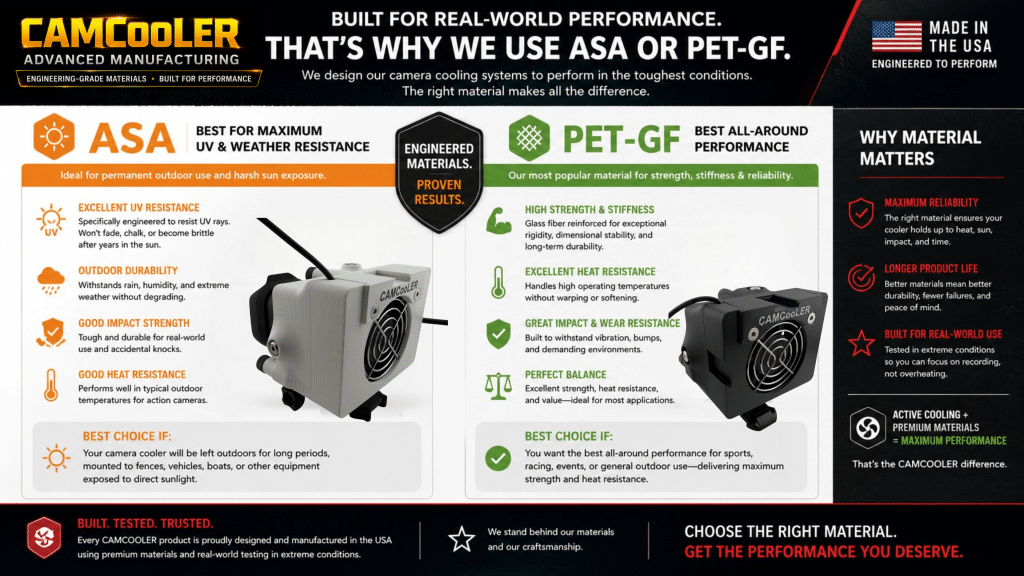
camcooler material guide
Choosing the Right Material for Your Cooler
Our coolers run in real heat—ballfields, race cars, airplanes, rocket-testing, dash cameras. All tested in the desert direct sun. That’s why we pick polymers that can survive it.
Here’s how ASA, PET-GF, PPA-CF, and PPS-CF stack up.
ASA
Acrylonitrile Styrene Acrylate
Best for long-term sun exposure
Our legacy outdoor material. ASA offers excellent UV resistance and reliable impact toughness, making it ideal for coolers that stay outside in direct sunlight for extended periods.
- Best weather/UV performance
- Smooth surface finish
- Good all-around durability
Recommended when the cooler lives outdoors continuously.
PET-GF (Glass-Fiber PET)
Polyethylene Terephthalate
Best balance: strength + outdoor use
Our preferred material for most coolers today. PET-GF keeps good UV performance but adds much higher tensile strength and excellent layer bonding for printed parts.
- Stronger than ASA under load
- Great for vibration/high-use parts
- Still outdoor capable
Best choice for most customers.
PPA-CF (Carbon-Fiber PPA)
Polyphthalamide
Best for high-temp, structural
Moves into engineering-grade territory. Very stiff, very strong, and handles higher temperatures than typical desktop materials.
- Higher heat deflection
- Excellent strength-to-weight
- For specialty or mission-critical setups
Usually more than a typical sports parent needs.
PPS-CF (Carbon-Fiber PPS)
Polyphenylene Sulfide
Best for extreme environments
This is the top end—used when parts must resist heat, chemicals, and mechanical load all at once.
- Outstanding thermal stability
- Chemical resistant
- Dimensionally stable
- Sounds like metal
Overkill for most camera-cooling use, but we know how to build with it.
If other products on Etsy or Amazon don’t tell you what it’s made of, there’s a reason — it’s probably just a low-end hobbyist polymer, not something built for real-world performance.
Material Detail Information
ASA (Acrylonitrile Styrene Acrylate)
ASA is an engineering-grade thermoplastic material specifically designed as a weather-resistant alternative to ABS. It is highly regarded for its exceptional UV resistance, durability, and mechanical strength, making it the top choice for parts exposed to outdoor conditions or high temperatures.
Key Characteristics
- Exceptional UV Resistance: ASA’s primary advantage over ABS—does not yellow, become brittle, or degrade in direct sunlight over time, due to the replacement of butadiene with an acrylic ester elastomer.
- High Impact Strength and Durability: Tough and impact-resistant, suitable for end-use parts that endure stress and environmental exposure.
- Good Heat Resistance: Heat deflection temperature ~95–100°C (203–212°F), stable in hot environments.
- Chemical and Water Resistance: Resistant to many acids, oils, salts, and moisture.
- Low Moisture Absorption: More dimensionally stable than nylon and prints reliably.
PET-GF (Polyethylene Terephthalate)
PET-GF is a high-performance composite made of PET reinforced with glass fibers, providing superior strength, stiffness, and heat resistance. This industrial-grade material excels in applications requiring high durability and stability under mechanical load or heat.
Is it safe to handle? Yes. Glass-filled plastics are safe when intact, but avoid touching broken parts with bare hands, as sharp glass fibers can be exposed.
Key Characteristics
- Enhanced Strength and Rigidity: Glass fiber reinforcement yields higher tensile strength and stiffness than standard ASA.
- High Dimensional Stability: Reduced warping and shrinkage during cooling for precise parts.
- Improved Heat Resistance: HDT around 99°C, up to 120°C with annealing.
- Low Moisture Absorption: Provides stable performance over time and consistent print quality.
- Chemical and UV Resistance: Retains PET’s resistance to solvents, acids, and UV exposure.
- Electrical Insulation: Non-conductive, unlike carbon fiber composites—ideal for electronic components.
PPA-CF (Polyphthalamide)
PPA-CF combines a high-temperature nylon base (PPA) with chopped carbon fibers, resulting in exceptional mechanical and thermal performance. It’s a premium material suitable for demanding industrial or automotive environments.
Key Characteristics
- Exceptional Strength and Rigidity: Offers near metal-like mechanical properties.
- Superior Heat Resistance: Maintains structure under sustained exposure up to 227°C.
- Ultra-Low Moisture Absorption: Much lower than standard nylons, ensuring stability in humid or wet conditions.
- Excellent Chemical Resistance: Tolerates oils, fuels, acids, and salts.
- High Dimensional Stability: Carbon fibers minimize warping during printing.
- Wear and Creep Resistance: Low friction, excellent for moving or load-bearing components.
PPS-CF10 (Polyphenylene Sulfide)
PPS-CF10 is an ultra-performance composite consisting of Polyphenylene Sulfide and 10% carbon fiber. Known for its extreme heat, chemical, and flame resistance, PPS-CF10 is used in aerospace, automotive, and electronic industries.
Key Characteristics
- Exceptional Heat Resistance: HDT over 250°C (≈253°C at 0.45 MPa per Polymaker), maintaining rigidity in extreme heat.
- Excellent Chemical Resistance: Resists acids, bases, fuels, and solvents—ideal for chemically harsh environments.
- Superior Flame Retardancy: Naturally flame-retardant; UL94 V0 rated (self-extinguishing).
- High Strength and Stiffness: Carbon fiber reinforcement provides metal-like rigidity and strength.
- Low Moisture Absorption: ~0.05%, ensuring long-term dimensional accuracy in humidity.
Material Mechanical Property Comparison
| Property | ASA | PET-GF | PPA-CF | PPS-CF10 |
|---|---|---|---|---|
| Material Full Name | Acrylonitrile Styrene Acrylate | Polyethylene Terephthalate | Polyphthalamide | Polyphenylene Sulfide |
| Additive | None | Glass Fiber | Carbon Fiber | Carbon Fiber |
| Percent of Additive | 0% | 15% | 25% | 10% |
| Young’s Modulus (X-Y) (MPa) | 2379 | 4144 | 9300 | 5446 |
| Young’s Modulus (Z) (MPa) | 1965 | 3428 | — | 2790 |
| Tensile Strength (X-Y) (MPa) | 43.8 | 59.9 | 112 | 59.4 |
| Tensile Strength (Z) (MPa) | 32 | 48.2 | — | 32 |
| Bending Modulus (X-Y) (MPa) | 3206 | 3705.4 | 8700 | 4646 |
| Bending Modulus (Z) (MPa) | — | 2998.4 | — | 2619 |
| Bending Strength (X-Y) (MPa) | 73.4 | 104.2 | 178 | 94.3 |
| Bending Strength (Z) (MPa) | — | 80.3 | — | 30 |
| Elongation at Break (X-Y) (%) | 6.7 | 4.0 | 2.25 | 1.4 |
| Elongation at Break (Z) (%) | 1.65 | 2.6 | — | 1.6 |
| Charpy Impact (X-Y) Notched (kJ/m²) | 10.3 | 8.7 | 13.1 | 5.3 |
| Charpy Impact (X-Y) Un-Notched (kJ/m²) | — | 27.2 | — | 11.4 |
| Charpy Impact (Z) Un-Notched (kJ/m²) | — | 13.9 | — | 4.1 |
How to Interpret the Material Data
What It Means Practically
- High Young’s Modulus → very stiff and resists deformation (e.g., carbon fiber, metals, glass-filled polymers).
- Low Young’s Modulus → more flexible or elastic (e.g., rubber, flexible plastics).
- Higher Tensile Strength → stronger, more rigid part, less likely to deform.
- Lower Tensile Strength → more flexible or ductile material, better impact absorption but less structural rigidity.
- Higher Bending Modulus → stiffer material that resists bending (like carbon fiber or metal).
- Lower Bending Modulus → more flexible; bends more easily (like nylon or rubber).
- Higher Bending Strength → can handle more force before breaking → stronger, more durable.
- Lower Bending Strength → cracks or fails more easily under bending loads.
- Higher % Elongation → more flexible or ductile; can stretch before breaking.
- Lower % Elongation → more brittle; breaks with little stretching.
- Higher Charpy Impact Strength → material bends or dents before breaking (tough).
- Lower Charpy Impact Strength → snaps cleanly under impact (brittle).
Understanding (X-Y) vs (Z) Direction
In FDM manufacturing and polymer testing:
- (X-Y) = properties measured along the print layers — the flat plane where the nozzle moves.
- (Z) = properties measured between layers — vertically through the layer stack.
Think of it like a stack of pancakes:
- It’s hard to tear one pancake apart sideways (strong in X-Y).
- But easier to peel one pancake off the stack (weaker in Z).
MPa = megapascals, a measure of stress or strength (force per unit area).